


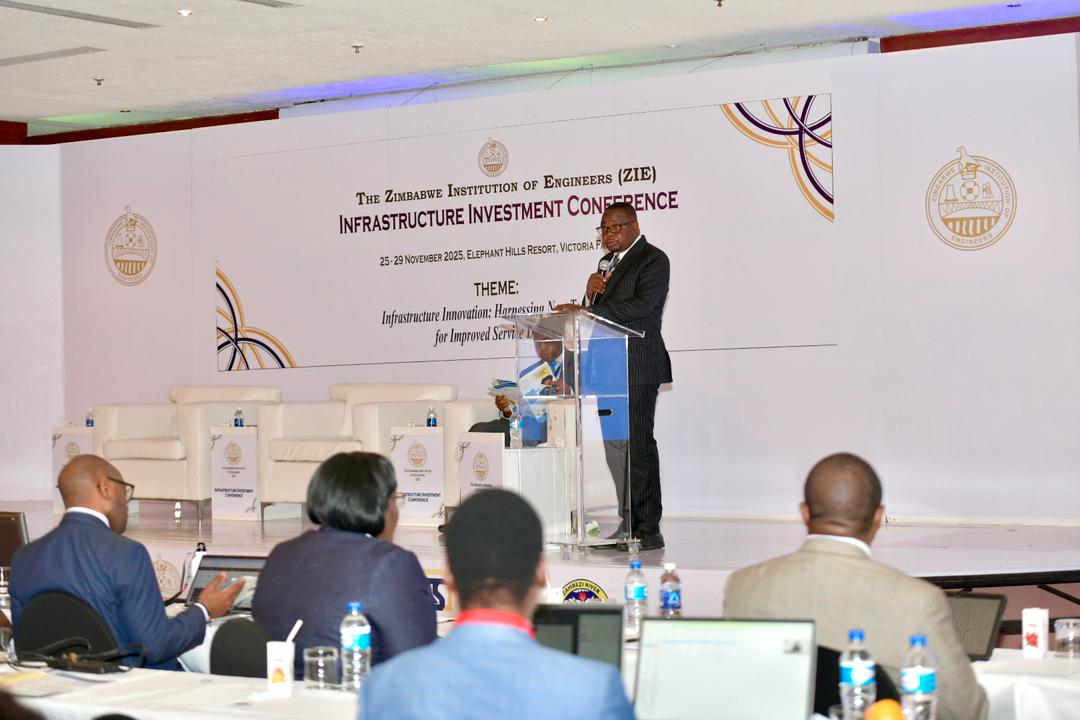
REMARKS BY THE MINISTER OF SKILLS AUDIT AND DEVELOPMENT, HONOURABLE PROFESSOR P. MAVIMA (MP), AT THE ZIMBABWE INSTITUTE OF ENGINEERS INFRASTRUCTURE INVESTMENT CONFERENCE, ELEPHANT HILLS, VICTORIA FALLS, 24 NOVEMBER, 2025
Salutations
Director of Ceremonies;
Minister of Transport and Infrastructure Development, Hon. Felix Mhona, hereby represented By Hon. Deputy Minister, Joshua Sacco;
Deputy Minister of Mines and Mining Development, Hon. Dr. Eng. Caleb Makwiranzou;
Senior Government Officials here present;
President of the Zimbabwe Institute of Engineers, Prof. Eng. William M. Goriwondo;
ZIE Past Presidents, Board Members, the C. E. O and all members;
Engineering Council of Zimbabwe Chairperson, C.E.O and Council Members;
Construction Industry Federation of Zimbabwe President, C.E.O and members;
Uganda Institute of Engineers President, Eng. Bosco Lepi;
Nigeria Society of Engineers, Dr Eng. Bola Mudasiru;
Industry Experts and the Academia;
Distinguished Guests;
Ladies and Gentlemen
It is an honour to address the Zimbabwe Institute of Engineers Infrastructure Investment Conference, an important platform that brought together the minds, hands, and visionaries responsible for shaping the backbone of our nation’s progress. Infrastructure is the lifeblood of every economic activity, and at the centre of designing, constructing, maintaining, and safeguarding that lifeblood are the people I am addressing today, our engineers. We cannot speak of national development, we cannot speak of Vision 2030, we cannot speak of economic acceleration, sustainability, and resilience, without inevitably speaking about the work, discipline, innovation, and integrity of engineers. Hence, this conference is a national strategic engagement about the future of Zimbabwe’s growth trajectory.
As the Ministry of Skills Audit and Development, we are tasked to continuously assess the skills landscape of our country and the alignment of human capital with our national priorities such as digital transformation, industrialization, climate resilience, and infrastructure modernization. When we assessed the skills landscape in 2024, one consistent finding is that engineering remains one of the most decisive and high-impact skill needed for national prosperity. When you imagine the growth of every sector you will understand that engineers are the architects of physical progress: from roads that strengthen regional integration, to water and sanitation systems that safeguard public health, to energy systems that power industries, to digital infrastructure that connects citizens to the opportunities of the world. It is therefore urgent that Zimbabwe does not only produce engineers, but engineers of the highest calibre; engineers that are ethical, innovative, future-ready, and driven by a deep devotion to excellence and national service.
Engineers play multiple critical roles in infrastructure investment through the provision of technical expertise that enables government and investors to translate national aspirations into actionable, bankable, and sustainable projects. Their knowledge ensures that projects are properly conceptualised, costed, and aligned with long-term development frameworks such as NDS1, NDS2, and Vision 2030. Engineers also serve as custodians of quality, safety, and environmental stewardship. They ensure that infrastructure does not only get built quickly, but built correctly, efficiently, and responsibly. They are also invaluable advisors on risk, resilience, and innovation, helping both government and private sector institutions to adopt solutions that stand the test of time. In an era of rapid technological change, climate uncertainty, and rising economic complexity, engineers must be both problem-solvers and futurists, anticipating challenges before they appear, and crafting solutions that elevate all communities.
 However, the strength of our national engineering capacity depends not only on technical skills but also on character. Major infrastructure projects demand individuals who embody integrity, discipline, accountability, and honesty. Corruption and poor workmanship are enemies of development; they derail national budgets, compromise public safety, and erode trust. Therefore, engineers must be guided by the highest ethical standards, because the strength of our infrastructure is ultimately the strength of our national values. Excellence must be non-negotiable. Precision must be habitual. Transparency must be instinctive. Engineers who carry these attributes do not only construct roads and dams, but they build confidence, dignity, and hope within the nation. As government, we rely heavily on the engineering profession to be a shining example of ethical leadership within technical practice.
Beyond ethics, there are critical attributes that engineers must possess to drive impactful national projects. They must be analytical thinkers capable of diagnosing complex challenges and proposing practical, data-driven solutions. They must be multidisciplinary, comfortable navigating economics, environmental science, digital technologies, management, and public policy. They must be adaptable, able to work in environments that demand quick decision-making, innovation, and cross-sector collaboration. You must also have strong communication skills to enable you to articulate technical concepts to policymakers, financiers, communities, and international partners is essential for mobilising investment and fostering stakeholder buy-in. Above all, you must have a passion for national development, a deep understanding that the bridges they build, the innovations they create, and the systems they design are instruments of nation-building.
To meet the evolving demands of infrastructure investment, engineers today must also master a range of emerging and future skills. Digital engineering, including Building Information Modelling (BIM), digital twins, and simulation technologies, is now central to project planning and execution. Artificial intelligence and data analytics are revolutionizing infrastructure monitoring, predictive maintenance, and risk assessment. Smart infrastructure systems, whether in transport, energy, housing, or water, require engineers who can integrate sensors, automation, IoT, and real-time analytics into project design. Green engineering skills are increasingly essential, as Zimbabwe advances its climate adaptation strategies, renewable energy targets, and environmental sustainability commitments. Skills in renewable energy systems, circular economy design, waste-to-energy technologies, and eco-friendly materials must be mainstreamed across engineering training and practice.
 As a Ministry, we encourage institutions of higher learning and professional bodies to embed business-oriented skills into engineering curricula, so that Zimbabwean engineers become globally competitive and investment-ready.
At the core of the future engineering workforce is a commitment to lifelong learning. The pace of technological advancement means that yesterday’s skills may not be sufficient for tomorrow’s challenges. Engineers must continuously upgrade their knowledge through professional development, certifications, attachments, and participation in global knowledge networks. We urge the Zimbabwe Institute of Engineers to continue offering robust professional development pathways and to strengthen partnerships with local universities, regional bodies, and international engineering associations. As government, we remain committed to creating enabling environments for skills development, research, and innovation to flourish. Our national productivity will only rise if we invest in engineering skills that match global standards. Infrastructure requires skills; skills require investment; investment requires confidence; and confidence is built through professionalism, competence, and excellence. That is why we view the engineering profession not only as a technical community, but as a national strategic asset.
As I conclude, let me reiterate that infrastructure investment is not just about concrete, steel, and technology, but it is about people. It is about enabling a child in rural Zimbabwe to cross a safe bridge on the way to school. It is about enabling a farmer to transport produce to markets through good roads. It is about enabling industries to access reliable energy, cities to grow sustainably, and communities to live dignified lives. Engineers are the builders of this hope. They are the designers of progress. And they are the custodians of the future. Let us therefore recommit ourselves to excellence, integrity, innovation, and patriotic dedication. Let us build not only structures, but a legacy.
To the Zimbabwe Institute of Engineers, I commend your leadership and steadfast contribution to national development. To all engineers present here, I applaud your service to Zimbabwe. May this conference strengthen your resolve and inspire new collaborations that will move our country forward.
My God bless you. May God bless our beloved nation Zimbabwe.
Thank you.