

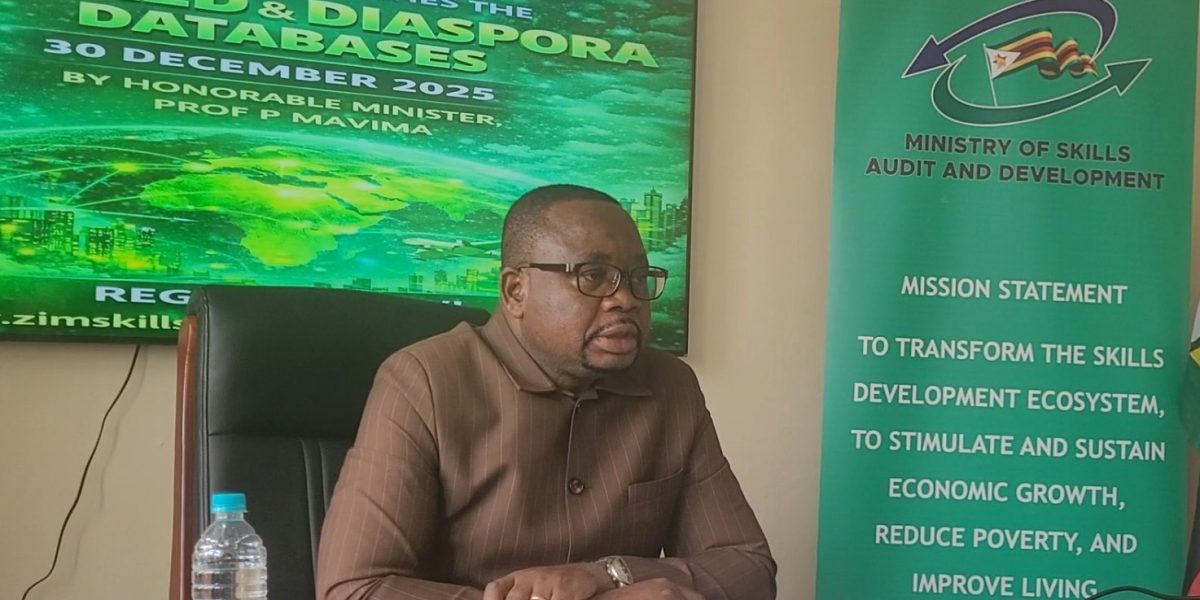
Zimbabwe has taken a decisive step towards mobilising its human capital with the official launch of two groundbreaking platforms: the Retired Experts Skills Database and the Diaspora Skills Database.
Minister of Skills Audit and Development, Professor Paul Mavima, unveiled the systems on 30 December 2025 at the Ministry’s headquarters in Harare, marking a historic moment in the country’s development trajectory.
The launch addresses a critical gap that has long existed in Zimbabwe’s development architecture. For years, the nation has produced highly trained professionals who have served with distinction across multiple sectors, from healthcare and engineering to education and technology. Many of these experts have retired with invaluable institutional memory, while millions of Zimbabweans abroad continue to excel in global markets. Until now, there has been no centralised mechanism to systematically identify, organise, and deploy this wealth of expertise for national development.
“Over the years, our nation has produced highly trained professionals who have served with distinction across the public sector, private industry, academia, and international institutions. Many of these experts have retired with invaluable institutional memory, while millions of Zimbabweans in the diaspora continue to excel globally in fields such as engineering, health, education, ICT, finance, science, and innovation.
Until now, however, there has been no centralised national mechanism to systematically identify, organise, and deploy this expertise for national development.
The launch of these two databases directly addresses this gap. They transform skills from being largely invisible assets into strategic resources that drive economic growth, service delivery, innovation, and national competitiveness,” the Minister said.
Professor Mavima emphasised that the databases transform skills from invisible assets into strategic resources that can drive economic growth, improve service delivery, spur innovation, and enhance national competitiveness. The initiative is fully aligned with President Mnangagwa’s Vision 2030, the National Development Strategy, and the principles of Education 5.0, which emphasise innovation, industrialisation, and problem-solving rooted in national heritage.
The Retired Experts Skills Database captures experienced professionals who have exited formal employment but remain willing and able to contribute through mentorship, consultancy, advisory roles, research, and short-term technical assignments. This framework repositions retirement not as an end of service, but as a transition into continued national contribution. The platform recognises that decades of experience and institutional knowledge should not be lost when professionals retire, but rather channelled towards building the next generation and strengthening critical national programmes.
The Diaspora Skills Database documents the skills and global exposure of Zimbabweans living and working abroad, enabling structured engagement through virtual collaboration, skills transfer, innovation partnerships, investment initiatives, and return programmes. Through this platform, Zimbabwe connects to global knowledge networks while strengthening national ties with its citizens scattered across continents. The database acknowledges that the diaspora represents a vast reservoir of expertise, international connections, and resources that can be strategically mobilised for national development.
Both databases are secure, web-based platforms hosted on Government infrastructure through the Ministry’s Skills Hub, ensuring data sovereignty, reliability, and long-term sustainability. They are accessible at www.zimskills.gov.zw and www.zimskills.gov.zw/skillshub/public, where individuals and organisations can register online. All registrations undergo verification and approval by the Ministry to ensure credibility, accountability, and system integrity.
Authorised users including Government institutions, local authorities, state enterprises, the private sector, academia, and development partners can search for skills by sector, profession, qualification, or experience, enabling targeted deployment of expertise to priority programmes and projects. The databases function as active tools for planning, implementation, and performance improvement, moving beyond mere record-keeping to become dynamic instruments for development.
The platforms have been developed in full compliance with the Cyber and Data Protection Act, with data security, confidentiality, and ethical use at their core. The information collected will be used strictly for development-oriented purposes, ensuring that contributors’ privacy and rights are protected while their expertise is effectively utilised.
The benefits of these databases extend across the entire national development spectrum. “The benefits of these databases are far-reaching. They support evidence-based policymaking, strengthen project implementation, enhance mentorship and skills transfer, promote innovation and technology diffusion, and improve coordination across sectors. Above all, they enable informed, data-driven decisions on skills deployment.”
Minister Mavima stressed that this is a national platform, not a Government-only initiative. He called upon all ministries, agencies, local authorities, the private sector, academia, and development partners to actively utilise these databases. To retired professionals and citizens in the diaspora, the Minister issued a clear message: your country still needs you. Zimbabwe invested in your education and training, and now there is a structured mechanism through which you can give back and continue contributing to national development from wherever you are.
The Minister commended the Ministry’s technical teams and all stakeholders who contributed to developing these systems, transforming policy intent into a tangible national asset. He noted that the launch represents more than a technological achievement. It is a strategic investment in Zimbabwe’s human capital and a clear affirmation that skills are the backbone of sustainable development.
The databases are now live and accepting registrations. Retired professionals with expertise across any sector are encouraged to register and make their skills available for mentorship, consultancy, and advisory services. Diaspora members, regardless of their current location or field of work, can register to contribute through virtual collaboration, periodic visits, or permanent return programmes. The registration process is straightforward and can be completed online, with Ministry support available for those who need assistance.
For organisations seeking expertise, the platform offers a powerful tool for accessing verified, experienced professionals who can provide guidance, fill knowledge gaps, support project implementation, and transfer critical skills. Whether it’s a local authority seeking urban planning expertise, a hospital needing specialist medical guidance, a university looking for visiting lecturers, or a private company requiring technical consultancy, the databases provide a centralised, reliable mechanism for connecting demand with supply.
As Zimbabwe moves towards achieving Vision 2030 and building an upper-middle-income economy, the Retired Experts Skills Database and the Diaspora Skills Database represent critical infrastructure for that journey. They embody the principle that development is fundamentally about people, their knowledge, and their willingness to contribute to collective progress. By systematically organising and deploying the nation’s accumulated expertise, Zimbabwe is creating a model for how countries can leverage their human capital, both at home and abroad, for sustainable development.