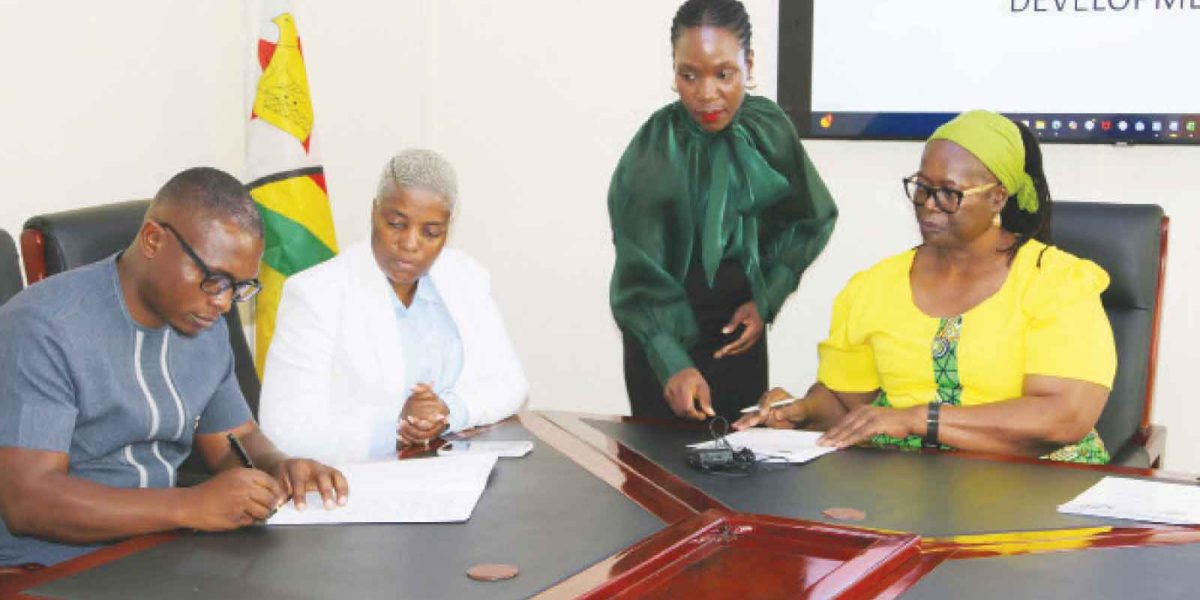
The Ministry of Skills Audit and Development has signed a landmark Memorandum of Understanding with Robokorda Zimbabwe (Private) Limited, marking a strategic partnership aimed at bridging critical digital skills gaps and preparing Zimbabwe’s youth for the demands of the digital economy.
Speaking at the signing ceremony on Thursday, the Permanent Secretary for Skills Audit and Development emphasized the timely nature of the partnership, describing it as aligned with President’s Vision 2030 and the principle of leaving no place and no one behind.
“This partnership comes at a timely and strategic moment in our national skills development journey. As the Ministry of Skills Audit and Development, we are committed to building a tech-savvy, innovative, and globally competitive Zimbabwe, in line with His Excellency the President’s Vision 2030,” Ambassador Chitiga said.
The Permanent Secretary outlined the Ministry’s core mandate of identifying, anticipating, and addressing skills gaps across all sectors of the economy to ensure Zimbabwe’s human capital development remains aligned with national priorities. The collaboration with Robokorda directly responds to this mandate by tackling the urgent need for robotics, coding, and digital literacy skills, particularly among young Zimbabweans.
Addressing the global context of digital transformation, the Permanent Secretary stressed that Zimbabwe must position itself as an active participant and innovator in the digital economy rather than remaining on the sidelines.
“The digital economy is no longer a future aspiration; it is a present reality. Across the world, robotics, coding, artificial intelligence, and digital platforms are reshaping how we work, learn, and create value. Zimbabwe cannot afford to be a spectator in this transformation.”
The MoU establishes a collaborative framework through which both parties will jointly address the mismatch between skills supply and labour market demand, tackle digital exclusion in rural and peri-urban communities, and prepare the workforce for emerging digital opportunities.
Key partnership objectives include:
- Roll out structured digital skills training programmes across all provinces
- Strengthen STEM and STEAM competencies nationwide
- Nurture creativity and innovation among Zimbabwe’s youth
- Build a pipeline of digitally skilled professionals in software development, robotics, and automation
- Extend digital skills training beyond traditional classroom settings
The partnership directly supports the National Development Strategy 2 (NDS2), which identifies science, technology, innovation, and digitalization as a national priority goal. Under the agreement, the Ministry will provide policy direction, coordination, and access to public institutions, while Robokorda brings technical expertise, curriculum innovation, and hands-on implementation capabilities.
The Permanent said, “By rolling out structured digital skills training programmes across all provinces, strengthening STEM and STEAM competencies, and nurturing creativity and innovation, we are contributing to NDS2’s vision of a digitally empowered Zimbabwe that is competitive regionally and globally.”
The Permanent Secretary commended Robokorda Zimbabwe for its role in the country’s digitalization efforts, praising the organization’s commitment to nurturing young talent and introducing innovative learning platforms that extend beyond conventional educational settings.
Emphasizing that the partnership represents more than a ceremonial exercise, the Permanent Secretary called for concrete action and measurable outcomes from the collaboration.
“The signing of this MoU is not a ceremonial exercise. It is a statement of intent. It signals our resolve to work collaboratively, to innovate, and to invest in skills that matter.”
The expected outcomes of the partnership include trained youth, empowered teachers, digitally inclusive communities, and a strengthened national skills ecosystem. By building this digital skills pipeline, Zimbabwe aims to position itself favorably for opportunities in emerging sectors including software development, robotics, digital entrepreneurship, and automation.
Looking ahead, the partnership is expected to create tangible pathways for young Zimbabweans to access digital economy opportunities while addressing the persistent challenges of skills mismatch and digital exclusion that have hindered the country’s technological advancement.
““Artificial intelligence is no longer a luxury; it is now a necessity. If Zimbabwe is to remain competitive, we must embed emerging technologies into our education and training systems to prepare learners for future workplaces. Together, we can build a digitally empowered Zimbabwe that truly leaves no place and no one behind,” she said.
Robokorda Zimbabwe chief executive officer, Mr Dambudzo Nyathi, said the MoU signifies a shift from policy formulation to practical implementation through structured collaboration.
“This partnership represents a move from policy to action. It is about empowering young people through digital inclusion, innovation, and enterprise development. Young people are at the centre of national transformation. By investing in their digital capabilities, we are laying a foundation for sustainable economic growth and competitiveness,” he said.
The signing ceremony marks the beginning of what both parties hope will be a transformative collaboration in advancing Zimbabwe’s digital skills landscape and preparing the nation’s workforce for the demands of the Fourth Industrial Revolution.